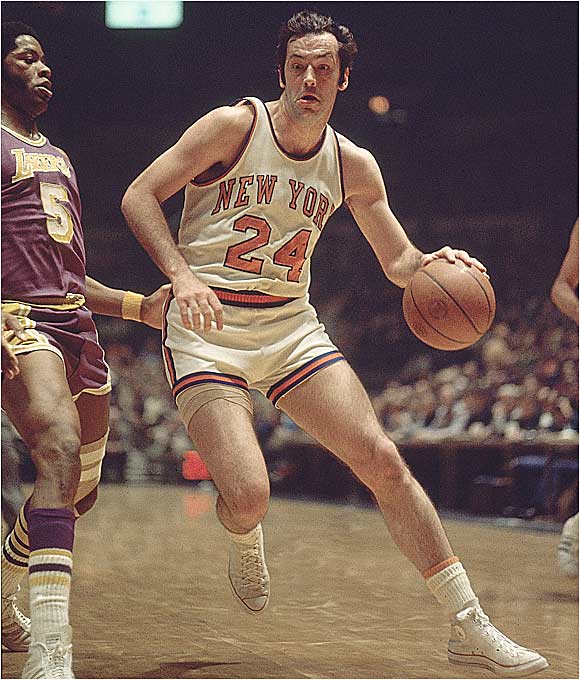
I was reading this post on James Altucher's blog recently. In it, he talked about the time he interviewed basketball legend Bill Bradley. You don't become a legend without putting in the work, even if you are almost seven feet tall. One of Bradley's challenges he imposed on himself as a practice drill was to make 15 baskets in a row from five different spots on the court. If he missed, he had to start over. I love this idea for improving consistency and stroke technique.
Adapting the concept for a tennis lesson offers endless possibilities.
Challenge your students to hit X balls into play in a row from a given location on the court. You can have them rotate in one ball at a time (hit-n-git) or they can stay in until they miss. First player to meet the challenge, wins.
Add hitting locations after each challenge is met. For example, hit 10 balls in, in a row, from the deuce side service line. Once this is accomplished, move in and hit from return of serve position. Then to baseline position (notice they are progressively more difficult!). Repeat on ad side, etc. If your students are beginners, this could take some time to accomplish, so you can spread it out over a series of sessions, or give them, let's say, the month of March to achieve the goal. Definitely offer recognition or prizes for the winners.
For young red ball players, keep the number of balls required under 10. If hitting consistently is too difficult, substituted catching and throwing to a target instead.
Showing posts with label consistency. Show all posts
Wednesday, February 18, 2015
Tuesday, December 16, 2014
Two and One
Another great drill from the folks at Tweener, this one taking it up a notch to combine consistency AND directional skills. Love it!
Coach feeds first ball to player cross court. Player must return two balls cross court, then one ball down the line. Coach then sends this DTL ball cross court, and player repeats sequence, now from other side of court.
Some options on adapting this drill for a group clinic of young beginners:
Place a colored spot or cone on each half of court on coach's side, say, red on deuce and green on ad. As they are hitting back to you, call out the color they are supposed to be targeting. Perhaps include side of court ( Red - Deuce! Green - Ad!) so they begin to understand where they are hitting to without the cone markers. Player stays in until they miss. Player hitting most balls in a row within a given time period, wins.
Relay style: Players hit one ball and move to end of line (hit-n-git!). Group is working together to see how many balls in a row they can hit to the correct spot.
Progression: Start this activity hitting from service line, then move back to baseline as students master it.
Coach feeds first ball to player cross court. Player must return two balls cross court, then one ball down the line. Coach then sends this DTL ball cross court, and player repeats sequence, now from other side of court.
Some options on adapting this drill for a group clinic of young beginners:
Place a colored spot or cone on each half of court on coach's side, say, red on deuce and green on ad. As they are hitting back to you, call out the color they are supposed to be targeting. Perhaps include side of court ( Red - Deuce! Green - Ad!) so they begin to understand where they are hitting to without the cone markers. Player stays in until they miss. Player hitting most balls in a row within a given time period, wins.
Relay style: Players hit one ball and move to end of line (hit-n-git!). Group is working together to see how many balls in a row they can hit to the correct spot.
Progression: Start this activity hitting from service line, then move back to baseline as students master it.
Thursday, December 11, 2014
One Minute Challenge
Thanks to the folks at the new tennis app, Tweener, for this simple yet effective consistency drill idea. I tried to embed the actual video but no worky, so try clicking on that link instead.
Players have one minute to hit 40 balls in play. In the video, the player is rallying with the coach. Player gets one point for every ball hit in. The catch is: they can only use one ball. So hitting consistently is key to keeping a rally going and eliminating wasted time chasing down the ball.
For young players you want to avoid anyone standing around waiting in line, even though it is only for one minute. If you have multiple courts available, great - have them pair up and play this challenge in singles half (longways) or full court. If you don't have multiple courts available, consider shortening the time period to 30 seconds, again to avoid lines and waiting. For young beginners I would also eliminate the 40 number and perhaps reduce it or just have the challenge be for who can get the most balls hit in play in the set time period.
Players have one minute to hit 40 balls in play. In the video, the player is rallying with the coach. Player gets one point for every ball hit in. The catch is: they can only use one ball. So hitting consistently is key to keeping a rally going and eliminating wasted time chasing down the ball.
For young players you want to avoid anyone standing around waiting in line, even though it is only for one minute. If you have multiple courts available, great - have them pair up and play this challenge in singles half (longways) or full court. If you don't have multiple courts available, consider shortening the time period to 30 seconds, again to avoid lines and waiting. For young beginners I would also eliminate the 40 number and perhaps reduce it or just have the challenge be for who can get the most balls hit in play in the set time period.
Tuesday, August 12, 2014
Nine Lives
I found this game on the Tennis Resources site. They had it in a doubles format, but I can see
using it in a variety of ways.
Teams start out with nine points each. Coach feeds in the first ball. Players play out the point. Losing team loses a 'life'. Play continues until one team is out of lives. Play best two out of three, with coach feeding a different team each round.
How about this singles variation, especially if you have odd numbers or a larger group: One player is on one end alone; all others are at the other end. One by one, they take on the singleton. All players begin with 9 Lives, losing one each time they lose a point. Player with the most lives when someone gets down to zero is the new singleton.
using it in a variety of ways.
Teams start out with nine points each. Coach feeds in the first ball. Players play out the point. Losing team loses a 'life'. Play continues until one team is out of lives. Play best two out of three, with coach feeding a different team each round.
How about this singles variation, especially if you have odd numbers or a larger group: One player is on one end alone; all others are at the other end. One by one, they take on the singleton. All players begin with 9 Lives, losing one each time they lose a point. Player with the most lives when someone gets down to zero is the new singleton.
Friday, July 18, 2014
Consistency Rally
Here's another rally drill from Lauren Stewart at The Woodlands. Again, suggested for 2.5 players but perfect for beginners of all ages. Another trait of 2.5 players is that they lack consistency. There's a drill for that. :)
Players pair up with a partner across the net and cross court. Play within the singles lines. Pairs/teams earn one point for every five ball rally achieved. First team to 5 points, wins. Switch sides (not ends) so players can get proficient on both sides of court.
If you have odd numbers of players, divide into teams and have them rotating in for whoever makes the error.
Progression
Play within service boxes with red or orange balls for easiest or for a good warm-up.
Start on 60 foot court with orange ball; progress to full court with green, then yellow balls.
Allow alleys. Two points for any ball landing in alley.
Players pair up with a partner across the net and cross court. Play within the singles lines. Pairs/teams earn one point for every five ball rally achieved. First team to 5 points, wins. Switch sides (not ends) so players can get proficient on both sides of court.
If you have odd numbers of players, divide into teams and have them rotating in for whoever makes the error.
Progression
Play within service boxes with red or orange balls for easiest or for a good warm-up.
Start on 60 foot court with orange ball; progress to full court with green, then yellow balls.
Allow alleys. Two points for any ball landing in alley.
Wednesday, April 30, 2014
Battle Spots
Battle Spots is a target activity similar to Battle Cones posted here previously. My students and I have a few modifications that we believe improves the game. I saw the original while I was taking the CoachYouthTennis online training sessions.
In both games, the object is to hit your opponents' spots/cones with your ball. I like the Spots version of this game because they are lower profile and less of a trip hazard for younger players. But they are also harder to hit. When we played straight-up Battle Spots with no modifications, it was almost impossible to eliminate all spots. As Ken DeHart has suggested, better to try to be the first player to hit ANY spot, and win. Another problem I had with this game is that players tended to park in front of or on top of their spots to protect them, and would not move to go after balls and play out the point because there was no benefit to winning the point - the motivation was stronger to protect the spots. However, with one simple modification suggested by one of my green ball students, a version of Battle Spots can be played where the first player/team to lose all spots, loses, and everyone is motivated to both play out the point as well as protect their spots.
Here's a recent lesson progression that worked great in orange, green and yellow ball classes recently.
I used a mini-tennis version of Battle Spots for our ball warm-up as follows.
For added fun and a fitness component, I had both teams playing this game in relay style: player 'hits and gits' - hit one ball, go to end of team line, next player plays next ball. This avoids the dreaded waiting in line syndrome and keeps everyone moving.
After the mini tennis version was completed, we took a water break. I moved the spots back to the T area and we played it again from the baseline.
We played this as relay singles, but it could easily be played as doubles.
In both games, the object is to hit your opponents' spots/cones with your ball. I like the Spots version of this game because they are lower profile and less of a trip hazard for younger players. But they are also harder to hit. When we played straight-up Battle Spots with no modifications, it was almost impossible to eliminate all spots. As Ken DeHart has suggested, better to try to be the first player to hit ANY spot, and win. Another problem I had with this game is that players tended to park in front of or on top of their spots to protect them, and would not move to go after balls and play out the point because there was no benefit to winning the point - the motivation was stronger to protect the spots. However, with one simple modification suggested by one of my green ball students, a version of Battle Spots can be played where the first player/team to lose all spots, loses, and everyone is motivated to both play out the point as well as protect their spots.
Here's a recent lesson progression that worked great in orange, green and yellow ball classes recently.
I used a mini-tennis version of Battle Spots for our ball warm-up as follows.
- An equal number of spots are put down on each side of the net. I put them about in the middle of the forecourt.
- Divide players into two teams.
- Teams take turn bounce-feeding and playing out the point.
- Object is to be the first team eliminate all of your opponent's spots.
- Spots may be eliminated either by being hit by opponent's ball, OR - here's the modification - whenever a team earns three points. Note: if one team gets three points, other team removes a spot. Team earning three points is reset to zero points. Team removing spots DOES NOT reset to zero and retains however many points they had when opponent got their three. This creates a fun, equalizing see-saw effect.
For added fun and a fitness component, I had both teams playing this game in relay style: player 'hits and gits' - hit one ball, go to end of team line, next player plays next ball. This avoids the dreaded waiting in line syndrome and keeps everyone moving.
After the mini tennis version was completed, we took a water break. I moved the spots back to the T area and we played it again from the baseline.
We played this as relay singles, but it could easily be played as doubles.
Monday, March 31, 2014
Kittens and Mittens
Another mash-up today. Title contributed from one of my students - thanks, Zeb! Super flexible, fun for any age and ability. You will need some extra equipment: cones, spots, and some random way of generating low numbers such as dice or playing cards.
Set up two cones anywhere you want the players to hit from (yellow cones in photo). At net for working on volleys, at service line for approach shots, baseline for groundies, etc. Cones should be 4-6 feet apart forming a 'goal'.
| Players will hit from yellow cones. Coach will feed from near/target side. |
Wednesday, March 19, 2014
Winner Take All
Winner Take All is a mash-up of several different games. I am sure you will recognize a few of them. I got the inspiration for it one morning while brushing my teeth. That 2 minute timer on the electric toothbrush sometimes seems like an eternity!Thursday, January 23, 2014
3 on 1
This drill is from Nick Bollettieri in the Jan/Feb 2014 issue of Tennis Magazine. He suggested it for a player who was having trouble hitting back to the opponent every time. I also like it for a good fitness and consistency workout for singles.
You will need at least four players. As the name suggests, play three on one end against one player in the other. You can set up any variety of scoring options:
- Play first to 7 then rotate (regardless of winner).
- Have all start with 7 points. Minus one point for every error. When someone gets to zero, rotate.
- Play 7/11. Trio must get 11 before singles player gets 7.
Tuesday, January 21, 2014
Shrinking Racquet
I came up with this one at random during a clinic with my older students. As always, I told them if they were going to miss, miss long. In other words, avoid hitting into the net.As further encouragement to avoid the net, I established a new rule: anyone hitting into the net must exchange their full size racquet for my 21" Sponge Bob racquet for the next point.
This elicited exactly the responses I was hoping for: anticipation by some; dread by some; wariness of the net by all. If you are going to try this, make sure your small racquet is the craziest, most colorful or, dare I say it - most baby-ish racquet you can find.
Tuesday, January 14, 2014
Rallyball
Presently I am holding a Rallyball competition among my students. Every Saturday throughout the
month of January, clinics will consist of a warm-up, then round robins with Rallyball scoring. I am awarding two overall prizes: one for most total points and one for Most Improved. Most Improved will be determined by who has the highest percentage increase between first match and best match.
RSVPs are helpful since you are playing singles and may need plenty of courts depending on your turnout.
Orange ball and higher:
Red ball:
This can be very tricky to count rallies, so some additional help from staff or parents will be greatly appreciated. Feed the first ball to players who are not able to serve well yet. I find clothespins very handy here to help us all keep track of score.
month of January, clinics will consist of a warm-up, then round robins with Rallyball scoring. I am awarding two overall prizes: one for most total points and one for Most Improved. Most Improved will be determined by who has the highest percentage increase between first match and best match.
RSVPs are helpful since you are playing singles and may need plenty of courts depending on your turnout.
Orange ball and higher:
- Singles round robin format of timed matches. How many rotations and how long they are depends on how many courts and players you have to work with. For a one hour clinic you can plan on about three 10-12 minute rotations after warm-up and including rotation and water break time, assuming you have plenty of courts. It helps to have even numbers of players so no one is sitting out. Sitting out means you are not earning points. If you are squeezed for courts, shorten the rotation time.
- Each player serves once from each side (deuce, ad). After four points (each player serving twice), players switch ends.
- Points are awarded per rally. Serve counts as one rally for server. Double fault awards one point to opponent. So for example if Player A serves, then a three ball rally occurs before server nets ball, 4 rallies have been completed (one serve and three rallies) so each player earns 2 points.
- Players report point totals to coach at end of each rotation. Players begin at 0 for each new rotation.
- Since we are playing over an entire month, points accumulate throughout the month. So the more they attend, the better chance they have to win. If some players aren't able to make every match and therefore are at a disadvantage for winning on overall points, remind them they still have a shot at winning Most Improved if they have plenty of long rallies.
Red ball:
This can be very tricky to count rallies, so some additional help from staff or parents will be greatly appreciated. Feed the first ball to players who are not able to serve well yet. I find clothespins very handy here to help us all keep track of score.
Saturday, November 9, 2013
Son of 5 Points
Last year I wrote about an activity called 5 Points. This is an update, inspired by an article in TennisPro magazine by Amy Pazahanick . It talks about the difference between hard skills and soft skills, which I also mentioned in the 5 Points post. So this reincarnation of 5 Points emphasizes hard skills for those days when you need to get back to basics and hit a ton of balls to hone technique. Best with small groups. Also I am going to present this activity as part of an entire lesson (as opposed to one activity during the lesson) centered around the number 5.Begin with a dynamic warm-up as follows:
All players set their racquets down on the court along the doubles sideline. Allow plenty of room between racquets. All players then go to far sideline and put a pile of 5 balls down directly across court from their racquets. When Coach says 'go', players move one ball at a time from their pile onto their racquet, using a medium jog. This is a warm-up, not a race. After all balls are on racquet, repeat activity with one big difference: instead of medium jog, all players are now facing the net and side shuffling rather than medium jog. Remember, this is a warm-up, not a race. Balls should be replaced into hopper. Look for good form on side shuffle - no galloping; eyes across net.
Once warm-up is complete, Son of 5 Points can begin as follows.
One player is on one side of net; all others are on other side. Coach hand-feeds five balls to the individual player. One point is earned for every ball hit into play. Players across net can also earn balls if they can catch one in the air or after one bounce. After 5 balls are fed, players rotate and a new player is now the hitter.
I start with forehands from the service line, then move back to baseline; then switch to backhands from the service line, and finish with backhands from the baseline. By this time, the hopper should be getting empty. Once it is empty, pick up all balls. Players keep their scores - we are not done yet!
Repeat activity with one difference: non-fed players are now hitting balls back rather than catching balls with their hands. Maximum two players returning at a time; others waiting to rotate in. Points awarded for every rally. So the points earned could be pretty high if you have some long rallies. Have your players responsible for keeping their own scores as this is nigh on impossible doing yourself if you have more than 3-4 players. Player with most points at end of second hopper emptying is the winner. Pay attention to hitting order and number of rotations so that all players get the same number of opportunities hitting.
Before picking up balls now, have all players retire to one side of court and warm up serves with balls on that side of court. By the time all of these balls are served to other side, all players should be plenty warmed up and ready to finish the lesson with some match play.
Thursday, October 24, 2013
Coach's Call
![]() |
| Poster available here |
consistently.
Players rally from the baseline until coach calls 'Play!'. Then and only then they proceed to play out the point. This teaches patience and 'staying in the point' until the right opportunity arises to end the point.
Adapted from "Live Ball: Let Them Play!" by Oliver Stephens, TennisPro Magazine, Sept/Oct 2013.
Tuesday, October 22, 2013
Plus 2
This is a simple consistency drill great for all but the youngest beginners. Players should be able to rally.
Challenge them to hit a serve, return and 2 additional rallies without an error. Do not play out the point, just these four shots. Put them on a timer and see how many times they can complete this successfully within the given time period. Rally must be quality shots from baseline - resist the urge to make it easy on them or let them take it easy on themselves :)
Adapted from "Live Ball: Let Them Play" by Oliver Stephens, TennisPro Magazine Sept/Oct 2013
Challenge them to hit a serve, return and 2 additional rallies without an error. Do not play out the point, just these four shots. Put them on a timer and see how many times they can complete this successfully within the given time period. Rally must be quality shots from baseline - resist the urge to make it easy on them or let them take it easy on themselves :)
Adapted from "Live Ball: Let Them Play" by Oliver Stephens, TennisPro Magazine Sept/Oct 2013
Wednesday, October 16, 2013
Short, Mid, Deep
Short, Mid, Deep is one of several drill ideas contained in a recent TennisPro Magazine article by PTR Master of Tennis Oliver Stephens.
Players play singles and are challenged to hit 10 balls in a row short to short. Then 10 more mid court to mid court, and finally 10 more baseline to baseline. Ideally they will get to the point where they can use one ball and keep this pattern going for a long time. It is not spelled out in the article but I think Oliver intends that the players do not stop between transitioning from short to mid to deep and back again.
Sunday, October 6, 2013
50 Ball Rally
I attended a PTR 11-17 certification this workshop and came away with some great drill ideas. This one is from Ashlee Creen, girls tennis coach at Brookland Cayce High School. Great for large groups, but you can make it work with as few as 4 players. Players should be able to volley and rally. No special equipment needed.
Divide players into two teams. Each team selects one player as their King or Queen. King/Queen takes up position at net. All other players on their team are at the opposite baseline. One at a time, they rally straight ahead relay fashion (baseline player hits one ball, then goes to end of line so next player can hit next ball). First team to 50 rallies, wins.
Variations
Divide players into two teams. Each team selects one player as their King or Queen. King/Queen takes up position at net. All other players on their team are at the opposite baseline. One at a time, they rally straight ahead relay fashion (baseline player hits one ball, then goes to end of line so next player can hit next ball). First team to 50 rallies, wins.
Variations
- If they miss, they don't necessarily have to start over at zero - that is completely up to you.
- Switching out King/Queen - you can do this after each round of 50, or devise some method of having them switch during play. For example, if net player mis-plays a ball, they have to switch with whomever they were playing against.
- Limit to specific shots, such as players must hit only backhands, or net player must hit volleys.
This game generated a high level of enthusiasm, camaraderie and competition. I will def be trying it soon with my own students.
Wednesday, June 12, 2013
Tic Tac Toe
Thanks Mike Barrell at evolve9 for adding to our collection of children's games converted to our tennis purposes with Tennis Tic Tac Toe.Players play singles or doubles with the usual rules EXCEPT they may only earn a point after earning three consecutive points.
I'll let that sink in for a minute.
Yes, finishing a game could take a while. But the lesson on the value of consistency and momentum is worth the trouble.
Monday, June 10, 2013
Sorry, Charlie!
Sorry, Charlie! is a result of instant inspiration on court recently when something wasn't working and I
had to think fast and switch gears. I like the result and I hope you do, too!
I was using this for young red ball players at the beginner level. Two players face off across the net from each other. On one side, player or coach has created a large target. I put my target smack-dab in the middle of the 36-foot court, more or less a circle about 4 feet in diameter. Remember these were beginners and I wanted to make this doable for them. Make the target out of flat spots or stripes as one player will be playing on this side.
Player on side WITHOUT target hits self-fed or coach fed ball across net, trying to make it bounce somewhere inside the target. If successful, other player returns ball and continues rally.
If the ball does NOT land in the target, player on side of net with target does not have to hit the ball and replies, "Sorry, Charlie!" to let the other player know their ball did not hit the target.
So we have one player working on feeding/targeting skills, and the other working on tracking, calling lines, and returning skills.
One point for every fed ball that lands in the target. Halfway through an average size hopper, switch roles and give the returning player a chance to self-feed. Player with most points when hopper is empty is the winner.
If you have a large group and half a hopper is too long of a rotation, give each player a fixed number of chances such as 10 balls per player.
To make it more difficult, have the first ball fed to backhand, or shrink/move target.
![]() |
| Your young students will have no idea who this is. I always felt badly for Charlie and all those years of rejection. Very fishy! |
I was using this for young red ball players at the beginner level. Two players face off across the net from each other. On one side, player or coach has created a large target. I put my target smack-dab in the middle of the 36-foot court, more or less a circle about 4 feet in diameter. Remember these were beginners and I wanted to make this doable for them. Make the target out of flat spots or stripes as one player will be playing on this side.
Player on side WITHOUT target hits self-fed or coach fed ball across net, trying to make it bounce somewhere inside the target. If successful, other player returns ball and continues rally.
If the ball does NOT land in the target, player on side of net with target does not have to hit the ball and replies, "Sorry, Charlie!" to let the other player know their ball did not hit the target.
So we have one player working on feeding/targeting skills, and the other working on tracking, calling lines, and returning skills.
One point for every fed ball that lands in the target. Halfway through an average size hopper, switch roles and give the returning player a chance to self-feed. Player with most points when hopper is empty is the winner.
If you have a large group and half a hopper is too long of a rotation, give each player a fixed number of chances such as 10 balls per player.
To make it more difficult, have the first ball fed to backhand, or shrink/move target.
Friday, June 7, 2013
Tennis Infinity
Thanks again to our friends +PhysEdGames for inspiring this tennis activity. Perfect for large groups, festivals, PE classes, etc. You will need some stickers or clothes pins to track scores.
Distribute your players among your courts. Best if your courts are next to each other to speed up court rotation times. Extra players are stationed at the ends of the courts. This screen shot pertains to a school gym but it translates easily to tennis courts IMO.
At timed intervals, Coach stops play and calls a rotation. All players move one position to left or right depending on Coach's instructions. Every rotation should move one of the excess players at the ends onto court, so no one is left standing out too long.
Players play out points. At the end of each rotation, player with most points won gets one sticker or clothes pin to represent that he/she 'won' during that rotation. At end of activity, player with most stickers/pins, wins.
Thursday, June 6, 2013
Barnyard
The Internet is truly a beautiful thing - an embarrassment of information riches! Sorting through my Twitter connections recently, I came across +PhysEdGames. If you follow my blog or tweets, you know lots of my tennis game ideas are modified children's games. Barnyard is one that is ripe for conversion. The video reminded me of the old Red Rover game from my childhood lo those many years ago when dinosaurs roamed the earth.
Barnyard's roots being in a PE class setting, it is a natural for large groups. But I can also see how we can use it in a tennis clinic with a smaller group.
One player is designated the Farmer and is at the net. Across the net at the baseline are all other players. They have been broken into different groups, designated by various farm animal names such as Duck, Cow, Goose, Goat, etc. Coach or Farmer calls out an animal. That animal or a player from that group of animals comes forward. Coach feeds ball; player hits. If he/she gets ball safely by Farmer at net, they earn one point for themselves or their animal group, and back into group they go. However if they miss or if Farmer picks off their ball at the net, they are 'out' and must trot over to far baseline.
What happens here is up to you. You can either task them with catching a ball to free themselves and return to the hitting group, or have them pick up X number of balls and deposit them into the hopper before getting back into hitting group.
First player or group to 7 points wins and is the new Farmer. If it is a group that wins, let them figure out who gets to be the next Farmer.
Barnyard's roots being in a PE class setting, it is a natural for large groups. But I can also see how we can use it in a tennis clinic with a smaller group.
One player is designated the Farmer and is at the net. Across the net at the baseline are all other players. They have been broken into different groups, designated by various farm animal names such as Duck, Cow, Goose, Goat, etc. Coach or Farmer calls out an animal. That animal or a player from that group of animals comes forward. Coach feeds ball; player hits. If he/she gets ball safely by Farmer at net, they earn one point for themselves or their animal group, and back into group they go. However if they miss or if Farmer picks off their ball at the net, they are 'out' and must trot over to far baseline.
What happens here is up to you. You can either task them with catching a ball to free themselves and return to the hitting group, or have them pick up X number of balls and deposit them into the hopper before getting back into hitting group.
First player or group to 7 points wins and is the new Farmer. If it is a group that wins, let them figure out who gets to be the next Farmer.
Subscribe to:
Posts (Atom)


